Sign in or create a free account

It's free: your chats are saved and appear in the sidebar on any device. New here? Signing in creates your account. You can also keep chatting without one; nothing is saved. See how Pinguide handles your data (opens in a new tab).

How to use Pinguide

Pinguide is an AI pinball expert. Ask it anything about pinball, the way you'd ask a knowledgeable friend.

What you can ask

  • Rules and strategy for a specific machine: “How do I start multiball in Godzilla?”
  • Playing technique: flipper skills, nudging, tournament play
  • Buying, owning and repairing machines
  • History, designers, news and new releases

How answers work

  • Name a machine and Pinguide reads its library of rulesheets, strategy guides and manufacturer pages. The chips under the answer link to those sources.
  • For anything current (new releases, code updates, events, prices) it searches the web and links the pages it used.
  • “Thought process” opens a summary of how it worked the answer out.
  • Follow-up questions keep the context, so you don't need to repeat the machine name.

Tips

  • Use the machine's full name. If several machines share a name (Star Wars, for example), you get an answer for each.
  • Stop ends an answer early. Edit (on your message) and Retry (on the last answer) ask again. Copy copies the text.
  • Click a playfield photo to open it large, then zoom with the buttons, your mouse wheel, a pinch, or the + and − keys, and drag to look around.
  • Pinguide is AI and can make mistakes. For rule details that matter, check the linked rulesheet. 👍 and 👎 under an answer rate it; with a thumbs-down you can say what was wrong, which helps fix mistakes.
  • Need help with something else? Contact Pinguide.

Saving chats

  • No account is needed. Without one, your chats disappear when you close the tab.
  • Sign in with Google or an emailed link to keep your chats in the sidebar on any device, where you can search, rename and delete them. You can delete your account at any time. The privacy policy explains what's stored.

Checkpoint

Checkpoint

Data East USA Inc. · 1991

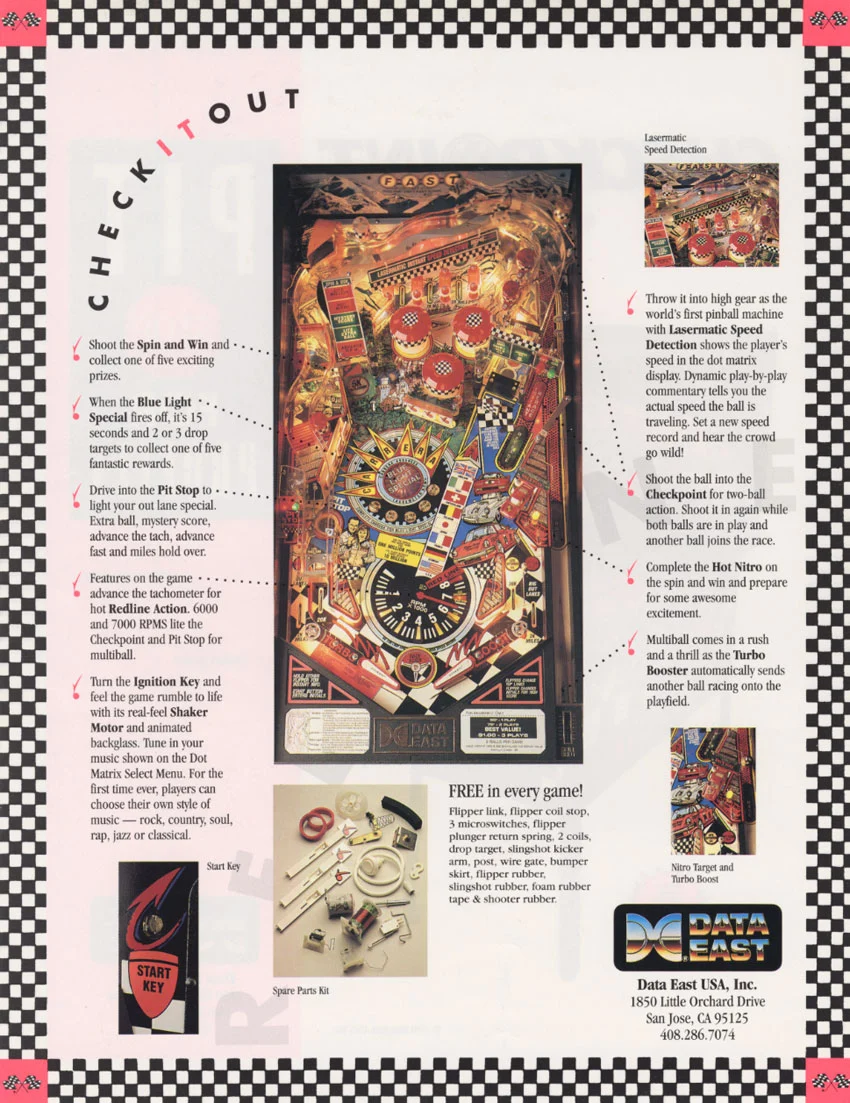
Checkpoint is a 1990s Data East pinball machine with a racing theme, where you build up an RPM value to unlock multiball and bonus opportunities. Its distinctive play centers on the tachometer-style RPM meter, a speed ramp that rewards fast shots, and short timed modes that reward aggressive, accurate play.

Ask Pinguide about Checkpoint

Building RPM and starting multiball

  • Raising the RPM value is the main goal, and it can be increased through several actions such as completing the L-A-P lanes and completing the Carrera drop targets.
  • Reaching the higher RPM thresholds sets up two-ball and three-ball multiball, with the Checkpoint and Pit Stop playing key roles in releasing balls.
  • Pop bumper hits also feed the RPM value, so keeping the bumpers active helps build toward multiball.

Main modes

  • FAST mode is started by lighting the FAST lights through the L-A-P lanes and then shooting the Checkpoint, and it is very short so it pays to hit the spinner or pop bumpers.
  • The Blue Light Special appears after a drop target is knocked down and gives a short window to clear the remaining targets for a bonus award.
  • The 1 Million and 10 Million ramp modes light the speed ramp for a brief time, so quick ramp shots are worth chasing.

Speed ramp and jackpots

  • The speed ramp is the only ramp on the table, and faster shots up it are worth more points.
  • During three-ball multiball, the jackpot must be lit by hitting the Checkered Flag target and then shooting the ramp before the timer runs out.
  • Jackpot values are shown on the backbox and change as the Carrera drop targets are completed.

Playfield
Design team

  • Design: Ed Cebula
  • Art: Paul Faris
  • Software: Rehman Merchant
  • Animation: Kristina Donofrio
  • Animation: Todd Farris
  • Design: Joe Kaminkow
  • Music: Brian Schmidt
  • Sound: Brian Schmidt

Sources

This overview was written by Pinguide's AI from the sources below. For rule details that matter, check the original rulesheet.

Updated 2026-11-22.