Sign in or create a free account

It's free: your chats are saved and appear in the sidebar on any device. New here? Signing in creates your account. You can also keep chatting without one; nothing is saved. See how Pinguide handles your data (opens in a new tab).

How to use Pinguide

Pinguide is an AI pinball expert. Ask it anything about pinball, the way you'd ask a knowledgeable friend.

What you can ask

  • Rules and strategy for a specific machine: “How do I start multiball in Godzilla?”
  • Playing technique: flipper skills, nudging, tournament play
  • Buying, owning and repairing machines
  • History, designers, news and new releases

How answers work

  • Name a machine and Pinguide reads its library of rulesheets, strategy guides and manufacturer pages. The chips under the answer link to those sources.
  • For anything current (new releases, code updates, events, prices) it searches the web and links the pages it used.
  • “Thought process” opens a summary of how it worked the answer out.
  • Follow-up questions keep the context, so you don't need to repeat the machine name.

Tips

  • Use the machine's full name. If several machines share a name (Star Wars, for example), you get an answer for each.
  • Stop ends an answer early. Edit (on your message) and Retry (on the last answer) ask again. Copy copies the text.
  • Click a playfield photo to open it large, then zoom with the buttons, your mouse wheel, a pinch, or the + and − keys, and drag to look around.
  • Pinguide is AI and can make mistakes. For rule details that matter, check the linked rulesheet. 👍 and 👎 under an answer rate it; with a thumbs-down you can say what was wrong, which helps fix mistakes.
  • Need help with something else? Contact Pinguide.

Saving chats

  • No account is needed. Without one, your chats disappear when you close the tab.
  • Sign in with Google or an emailed link to keep your chats in the sidebar on any device, where you can search, rename and delete them. You can delete your account at any time. The privacy policy explains what's stored.

Goldeneye

Goldeneye

Sega Pinball Inc. (US) · 1996

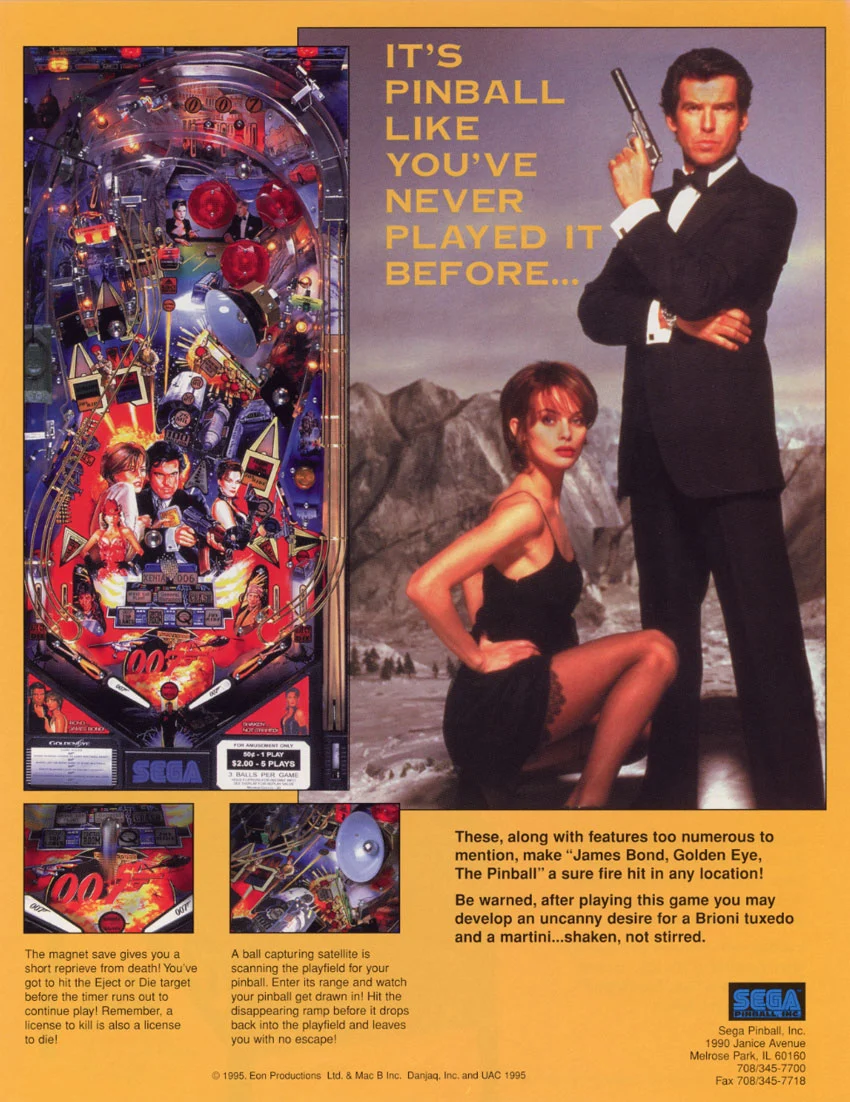
Goldeneye is a 1996 Sega pinball machine themed on the James Bond film of the same name, with a rotating satellite dish that can catch and hold a ball. Its standout features are the magnet-based ball saver that flings drained balls back into play and a set of 007 modes that lead toward a difficult wizard mode.

Ask Pinguide about Goldeneye

Satellite and multiball

  • The Satellite is a rotating dish with a magnet in its center, and a ball is loaded onto it by shooting the Pop-Up Ramp fed from the left inlane.
  • Two Virtual Locks light Satellite Multiball, which is the most valuable multiball in the game.
  • Tank Multiball can be lit from Satellite Multiball by hitting the Center Eject Target and is generally less rewarding, so many players abort it.

Ball saver and Eject or Die

  • A magnet catches balls that drain down an outlane and flings them back into play, with no clear notice to the player that the save happened.
  • Eject or Die is lit by completing Shootout and gives a short timed chance to hit the Center Eject Target before the ball is lost.
  • Stacked Eject or Die awards are useful since the game has no kickback.

Modes and the wizard mode

  • Five 007 Encounters are started at the Mode Start Lane, and each must be started and ended to progress toward the wizard mode.
  • The wizard mode requires several goals, including finishing Shootout, completing Q's Pen, spelling GOLDENEYE and completing the 007 top lanes.
  • Starting the wizard mode is widely considered the primary goal of the game.

Playing as a newer player

  • Shoot the ramps to build combos and spot letters in GOLDENEYE, since those shots form the core scoring during single-ball play.
  • Avoid spending too much effort on Q's Pen, which is difficult and worth comparatively little.

Playfield
Design team

  • Design: Ward Pemberton
  • Animation: Kurt Andersen
  • Software: Lonnie D. Ropp
  • Art: Jeff Busch
  • Mechanics: Rob Hurtado
  • Software: Orin Day
  • Art: Paul Faris
  • Animation: Mark Raneses
  • Software: Neil Falconer
  • Software: John Carpenter
  • Music: Brian Schmidt
  • Sound: Brian Schmidt

Sources

This overview was written by Pinguide's AI from the sources below. For rule details that matter, check the original rulesheet.

Updated 2026-11-22.