Sign in or create a free account

It's free: your chats are saved and appear in the sidebar on any device. New here? Signing in creates your account. You can also keep chatting without one; nothing is saved. See how Pinguide handles your data (opens in a new tab).

How to use Pinguide

Pinguide is an AI pinball expert. Ask it anything about pinball, the way you'd ask a knowledgeable friend.

What you can ask

  • Rules and strategy for a specific machine: “How do I start multiball in Godzilla?”
  • Playing technique: flipper skills, nudging, tournament play
  • Buying, owning and repairing machines
  • History, designers, news and new releases

How answers work

  • Name a machine and Pinguide reads its library of rulesheets, strategy guides and manufacturer pages. The chips under the answer link to those sources.
  • For anything current (new releases, code updates, events, prices) it searches the web and links the pages it used.
  • “Thought process” opens a summary of how it worked the answer out.
  • Follow-up questions keep the context, so you don't need to repeat the machine name.

Tips

  • Use the machine's full name. If several machines share a name (Star Wars, for example), you get an answer for each.
  • Stop ends an answer early. Edit (on your message) and Retry (on the last answer) ask again. Copy copies the text.
  • Click a playfield photo to open it large, then zoom with the buttons, your mouse wheel, a pinch, or the + and − keys, and drag to look around.
  • Pinguide is AI and can make mistakes. For rule details that matter, check the linked rulesheet. 👍 and 👎 under an answer rate it; with a thumbs-down you can say what was wrong, which helps fix mistakes.
  • Need help with something else? Contact Pinguide.

Saving chats

  • No account is needed. Without one, your chats disappear when you close the tab.
  • Sign in with Google or an emailed link to keep your chats in the sidebar on any device, where you can search, rename and delete them. You can delete your account at any time. The privacy policy explains what's stored.

Judge Dredd

Judge Dredd

Bally Manufacturing Co. · 1993

Judge Dredd is a Bally/Williams pinball machine built around a crime-fighting theme, with a large central planet used for multiball and a set of crime scenes that raise in severity as you shoot them. Its distinctive features are the chain-link mode cycle, a JUDGE drop-target lock that leads to multiball and jackpots, and a series of Super Games played one per ball.

Ask Pinguide about Judge Dredd

Starting multiball

  • Knock down the JUDGE drop targets in order to light the lock.
  • Shoot the left ramp once lock is lit so the ball is diverted into the Deadworld planet.
  • The third ball locked starts multiball, and the earlier locked balls are returned to play.
  • Collect jackpots by shooting the left ramp to light them and hitting the subway behind the wide D target.

Chain link modes

  • Start a mode by shooting the left ramp or the Sniper Tower, which alternate as the build-up shot.
  • Most modes run for about 30 seconds, and each mode offers a distinct display and scoring style.
  • Hitting the flashing question mark target during a mode gives an extra benefit tied to that mode.
  • Sniper and Manhunt Millions are best started from their own dedicated shots to avoid wasting time.

Crime scenes

  • Five crime scenes are spread around the playfield, and shooting one sentences a criminal to a harsher charge.
  • The Advance Crime Level target raises all lit scenes one level, up to Class X Felony.

Super Games

  • Super Games are four different two-ball games, and only one is played per ball.
  • Hitting the JUDGE drop targets quickly can start a six-ball frenzied multiball.

Playfield
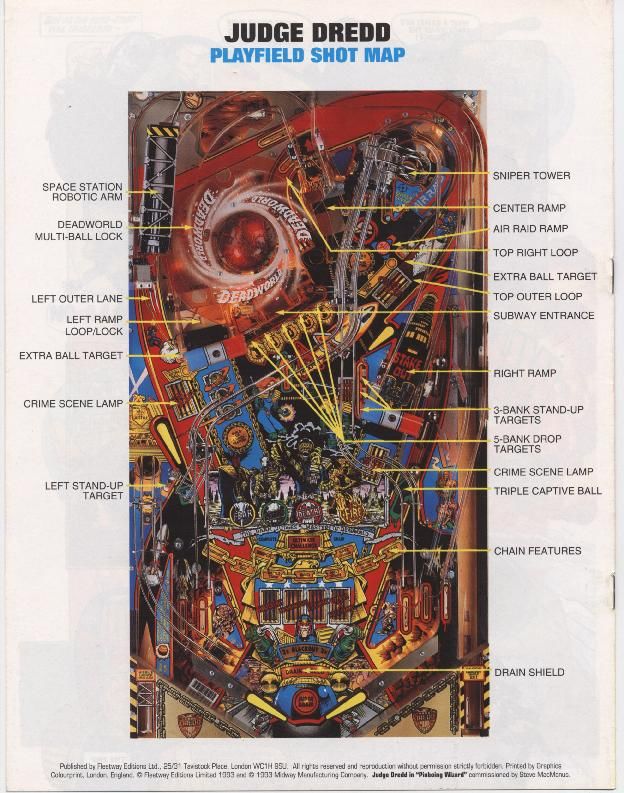
Design team

  • Art: Kevin O'Connor
  • Mechanics: Ernie Pizarro
  • Animation: Scott Slomiany
  • Design: John Trudeau
  • Callouts: Tim Kitzrow
  • Software: Jeff Johnson
  • Animation: Eugene Geer
  • Music: Paul Heitsch
  • Sound: Paul Heitsch
  • Music: Vince Pontarelli

Sources

This overview was written by Pinguide's AI from the sources below. For rule details that matter, check the original rulesheet.

Updated 2026-11-22.