Sign in or create a free account

It's free: your chats are saved and appear in the sidebar on any device. New here? Signing in creates your account. You can also keep chatting without one; nothing is saved. See how Pinguide handles your data (opens in a new tab).

How to use Pinguide

Pinguide is an AI pinball expert. Ask it anything about pinball, the way you'd ask a knowledgeable friend.

What you can ask

  • Rules and strategy for a specific machine: “How do I start multiball in Godzilla?”
  • Playing technique: flipper skills, nudging, tournament play
  • Buying, owning and repairing machines
  • History, designers, news and new releases

How answers work

  • Name a machine and Pinguide reads its library of rulesheets, strategy guides and manufacturer pages. The chips under the answer link to those sources.
  • For anything current (new releases, code updates, events, prices) it searches the web and links the pages it used.
  • “Thought process” opens a summary of how it worked the answer out.
  • Follow-up questions keep the context, so you don't need to repeat the machine name.

Tips

  • Use the machine's full name. If several machines share a name (Star Wars, for example), you get an answer for each.
  • Stop ends an answer early. Edit (on your message) and Retry (on the last answer) ask again. Copy copies the text.
  • Click a playfield photo to open it large, then zoom with the buttons, your mouse wheel, a pinch, or the + and − keys, and drag to look around.
  • Pinguide is AI and can make mistakes. For rule details that matter, check the linked rulesheet. 👍 and 👎 under an answer rate it; with a thumbs-down you can say what was wrong, which helps fix mistakes.
  • Need help with something else? Contact Pinguide.

Saving chats

  • No account is needed. Without one, your chats disappear when you close the tab.
  • Sign in with Google or an emailed link to keep your chats in the sidebar on any device, where you can search, rename and delete them. You can delete your account at any time. The privacy policy explains what's stored.

Lucky Seven

Lucky Seven

Williams Electronic Games Inc. · 1977–1978

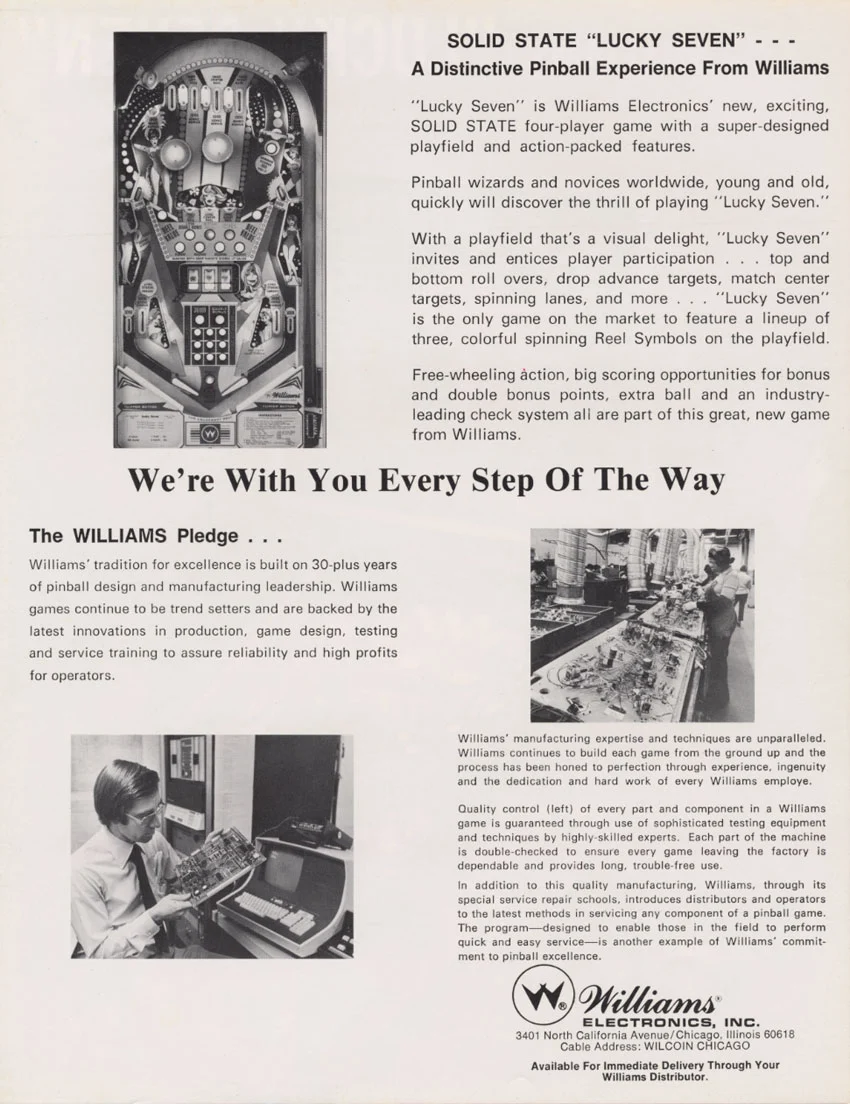
Lucky Seven is a 1978 Williams solid-state pinball machine for up to four players, known for its three-reel display that changes as you hit the top lanes and center targets. Scoring centers on a reel value you cash in by completing the side drop targets, while a bonus that can be doubled sits alongside it.

Ask Pinguide about Lucky Seven

Core Scoring Loop

  • Bonus builds in steps through the top lanes, return lanes and an upper stand-up target, so it can reach a high cap quickly.
  • The three reels change when you hit the color-matched top lanes or center stand-up targets.
  • The reel value is collected by completing the two drop targets on the sides of the playfield.
  • The spinner is lit by the return lanes but is worth very little, so it is mainly a route to the top lanes.

Doubling the Bonus

  • Doubling requires the right symbol combination on the three reels, with one or two clovers being the key pattern.
  • When the double bonus light is on, shooting the reel targets becomes the priority once bonus is high enough.
  • Center stand-up targets are only worth shooting when a single reel change completes the combination you want.

Playfield Risks

  • Balls rolling off the central mounting can drain down the middle or deflect into the slingshots.
  • Balls that barely clear the edge of a slingshot mount can be knocked into an outlane.
  • Most targets on the playfield can rebound back toward the drain, so aggressive shots near them carry risk.

Playfield
Design team

  • Software: Ron Crouse
  • Art: Christian Marche
  • Design: Chris Otis

Sources

This overview was written by Pinguide's AI from the sources below. For rule details that matter, check the original rulesheet.

Updated 2026-11-22.