Paragon
Paragon is a 1979 Bally solid-state four-player pinball machine widely regarded as one of the most popular games of its era. It is bonus-heavy, with a strong emphasis on building a bonus that can be locked in at set thresholds, and its playfield rewards careful control of the ball around inline drop targets, a spinner, and saucers.
Getting started
- Ball control is difficult, so slow the ball down and aim to get it onto a flipper from wherever it lands rather than panicking.
- Bonus advances are the top early priority, and the best ones come from the Valley of Demons, which also raises the bonus multiplier.
- Do not aim at the center standup target for bonus advances, since it is a poor choice.
- Reaching the 20K super bonus early is valuable because it is the hardest threshold to hit and can win a game if no one else has it.
Bonus and the spinner
- Bonus can be locked in at 20K, 30K and 40K, so pushing toward those thresholds is central to strategy.
- When the ball heads to the right flipper, you can either shoot the inline drop targets or the spinner beside them, and the right choice depends on how active the spinner is and how close you are to 20K.
- If the spinner is very active, it is often worth working it until the bonus reaches 20K before moving on.
Saucers and special scoring
- The upper left saucer, called Golden Cliffs, grows in value each time the ball lands in it and becomes one of the best scoring shots once it reaches 20K.
- Spelling PARAGON awards a special and points, and it works best when the PARAGON letters are not set to scan.
- The left side inline drop targets lead to an extra ball or multiplier saucer, and a few shots there may be rejected, so try again with adjusted speed.
Keeping the ball alive
- The upper left miniflipper is useful for keeping the ball up top and away from the lower left area, which is known as the Beast Lair and causes many losses.
- Most drains come from the bumper area, but rebounds from the inline drop targets and the far right waterfall exit can drain down the center.
Playfield
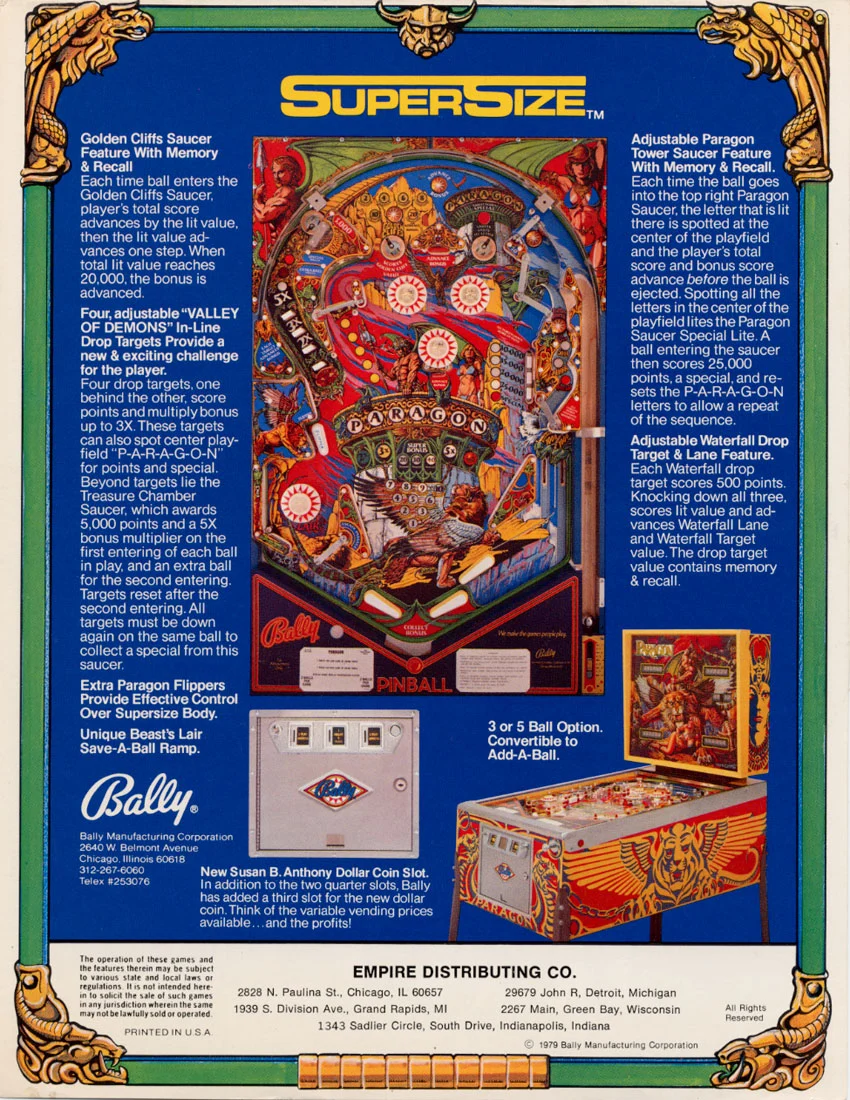
Design team
- Art: Paul Faris
- Design: Greg Kmiec
Sources
This overview was written by Pinguide's AI from the sources below. For rule details that matter, check the original rulesheet.
Updated 2026-11-22.