Sign in or create a free account

It's free: your chats are saved and appear in the sidebar on any device. New here? Signing in creates your account. You can also keep chatting without one; nothing is saved. See how Pinguide handles your data (opens in a new tab).

How to use Pinguide

Pinguide is an AI pinball expert. Ask it anything about pinball, the way you'd ask a knowledgeable friend.

What you can ask

  • Rules and strategy for a specific machine: “How do I start multiball in Godzilla?”
  • Playing technique: flipper skills, nudging, tournament play
  • Buying, owning and repairing machines
  • History, designers, news and new releases

How answers work

  • Name a machine and Pinguide reads its library of rulesheets, strategy guides and manufacturer pages. The chips under the answer link to those sources.
  • For anything current (new releases, code updates, events, prices) it searches the web and links the pages it used.
  • “Thought process” opens a summary of how it worked the answer out.
  • Follow-up questions keep the context, so you don't need to repeat the machine name.

Tips

  • Use the machine's full name. If several machines share a name (Star Wars, for example), you get an answer for each.
  • Stop ends an answer early. Edit (on your message) and Retry (on the last answer) ask again. Copy copies the text.
  • Click a playfield photo to open it large, then zoom with the buttons, your mouse wheel, a pinch, or the + and − keys, and drag to look around.
  • Pinguide is AI and can make mistakes. For rule details that matter, check the linked rulesheet. 👍 and 👎 under an answer rate it; with a thumbs-down you can say what was wrong, which helps fix mistakes.
  • Need help with something else? Contact Pinguide.

Saving chats

  • No account is needed. Without one, your chats disappear when you close the tab.
  • Sign in with Google or an emailed link to keep your chats in the sidebar on any device, where you can search, rename and delete them. You can delete your account at any time. The privacy policy explains what's stored.

Taxi

Taxi

Williams Electronic Games Inc. · 1988

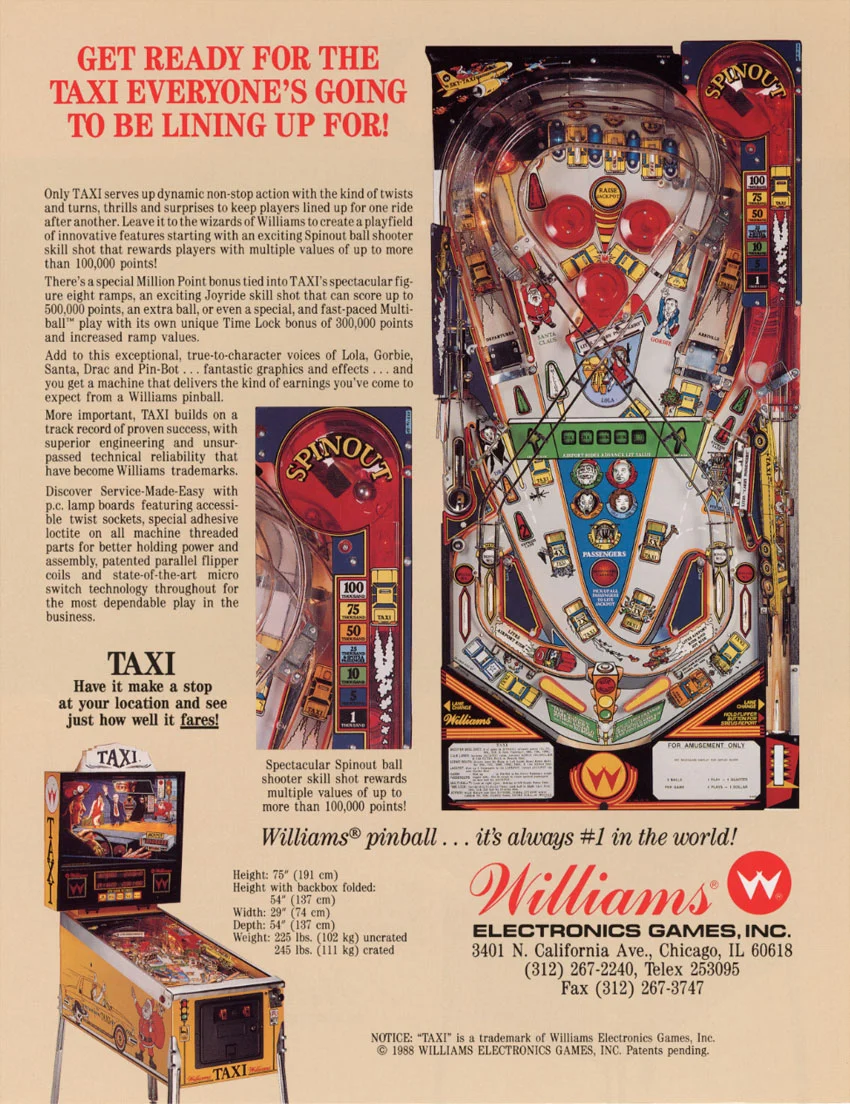
Taxi is a 1988 Williams pinball machine in a yellow New York taxi cabinet, built around collecting five passengers and chasing a large jackpot. Its distinctive play comes from the passenger pickup and drop-off sequence, the CAB rollovers that feed the jackpot, and the airport ramps that lead into multiball.

Ask Pinguide about Taxi

Getting started

  • Pick up passengers in the order the table lights them, beginning with GORBY and PINBOT at the start of a game.
  • Lighting all three CAB rollover letters raises the bonus multiplier and briefly boosts the jackpot.
  • Ramps score the current airport value, so lighting them with the inlanes is an early goal.

Jackpot and passengers

  • The jackpot is the main scoring target, so collecting it after all five passengers are picked up is the key objective.
  • Once the jackpot is collected, dropping passengers off in the required order relights it and an outlane for a special.
  • Carry Passengers is a small target that holds passengers for the next ball and is the easiest way to keep progress.

Multiball

  • Multiball starts by locking one ball in the right lock hole and then shooting the left ramp with another ball.
  • Both balls must be relocked through the Express lanes, with the second ball going into DRAC.

Ramps and tactics

  • The ramps are hard to hit cleanly, so a weak shot can roll back and drain.
  • If the left ramp is difficult, shooting the DRAC hole can award a left ramp airport advance instead.

Playfield
Design team

  • Software: Ed Boon
  • Mechanics: Tony Kraemer
  • Art: Python Anghelo
  • Concept: Python Anghelo
  • Callouts: Steve Ritchie
  • Design: Mark Ritchie
  • Callouts: Mark Ritchie
  • Concept: Mark Ritchie
  • Callouts: Chris Granner
  • Music: Chris Granner
  • Sound: Chris Granner
  • Callouts: Barry Oursler
  • Mechanics: Craig Fitpold
  • Mechanics: Mark Kim

Sources

This overview was written by Pinguide's AI from the sources below. For rule details that matter, check the original rulesheet.

Updated 2026-11-22.